
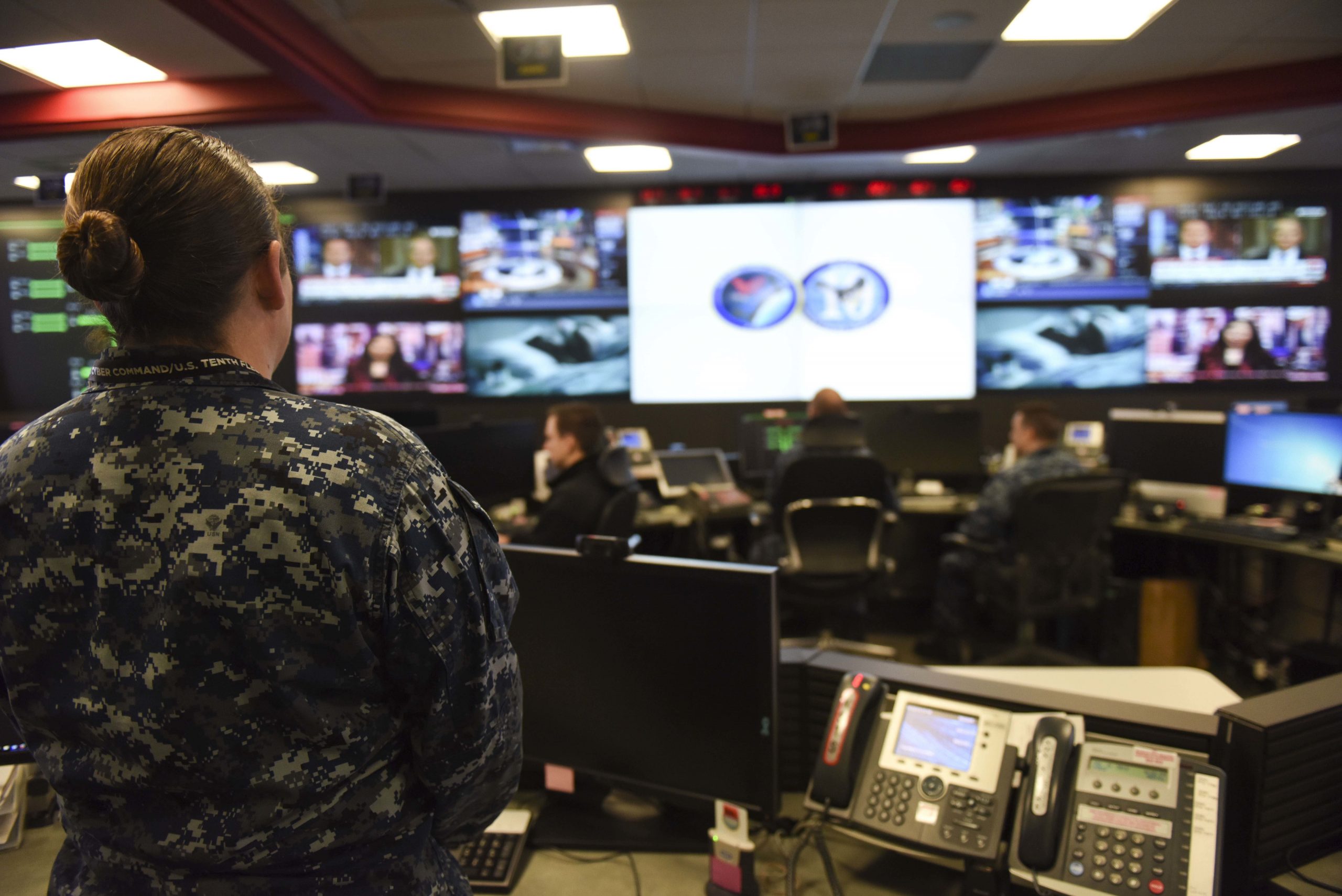
Following up on part 1, this article forms part 2 of the second instalment of our series on essential principles of international humanitarian law: precautions in attack. It addresses the special challenges of precautions in cyber attacks under Article 57 AP I with special consideration to non-kinetic effects and explains how artificial intelligence can be an enabler of IHL compliance in modern warfare.
Estimated reading time: 7 minutes
6. Cyber Operations and Non-Kinetic Effects: The Precautions Perspective
6.1 Cyber Operations
Cyber operations increasingly shape the modern battlefield, from intelligence gathering to neutralizing hostile capabilities without physical force. Precautions in cyber attacks under Article 57 AP I apply whenever a cyber operation qualifies as an “attack”. This can be assumed if it is reasonably expected to cause injury or physical damage. However, cyber operations that do not cause physical damage may still qualify as attacks under IHL. This can be the case if their foreseeable functional consequences disable or degrade critical infrastructure. The Tallinn Manual 2.0 affirms this understanding. It clarifies that cyber effects must be assessed not only for kinetic outcomes. Rather, functional consequences in critical systems must be considered as well.
Precautions in cyber operations
As the commentary to Rule 6 of the Tallinn Manual notes, serious adverse consequences include interference with the operation of critical infrastructure, such as hospitals or transportation networks, or a major impact on the economy even where no physical destruction occurs (Tallinn Manual 2.0, commentary to Rule 6, internal pp. 37–38 / PDF pp. 87–88).This interpretation is central to understanding precautions in cyber operations.
For commanders, this means that the must verify the nature of targets, assess potential risks to civilians, and choose means and methods that minimize incidental harm. Article 57’s feasibility standard is particularly relevant because cyber tools can offer highly discriminate, reversible options unavailable in many kinetic engagements. These capabilities reinforce the operational value of precautions in cyber attacks under Article 57 AP I.
Commanders must assess foreseeable affects
However, cyber operations also require tailored precautionary analysis. Their consequences may propagate through interconnected systems, making it essential to understand potential cascading effects on civilian life. In practice, responsible militaries mitigate these risks through rigorous testing, red-teaming, controlled execution environments, and real-time monitoring. These measures reflect the underlying logic of international humanitarian law precautions: commanders must assess foreseeable effects rather than eliminate all uncertainty.
Cyber capabilities can strengthen IHL compliance
Far from complicating compliance, cyber capabilities can strengthen it. Precision intrusions, geographically bounded malware, and reversible effects all expand the commander’s ability to neutralize threats while minimizing collateral harm. Used responsibly, cyber operations can therefore enhance—not weaken—civilian protection under international humanitarian law.
6.2 Non-Kinetic Effects
Non-kinetic operations—such as electronic warfare, jamming, spoofing, and electromagnetic interference—can have significant operational effects despite lacking physical force. Under precautions in cyber attacks under Article 57 AP I, these operations must be assessed for their foreseeable impact on civilians and civilian objects, just as kinetic attacks must. The Tallinn Manual 2.0 affirms that cyber and electromagnetic actions can rise to the level of an “attack”. This can be the case when they disable or degrade essential civilian functions, even without physical destruction. Cyber operations may constitute harmful effects when they “seriously degrade[s], obstruct[s], or interrupt[s]” communications or services …” (Tallinn Manual 2.0, commentary to Rule 63, internal p. 296 / PDF p. 346).
Cascading effects of cyber attacks require careful consideration
Because many non-kinetic effects propagate through networks or spectrum-dependent systems, militaries must evaluate potential cascading impacts—such as effects on medical facilities, emergency services, or air traffic management. These assessments are an essential component of international humanitarian law precautions in technologically complex operational environments. The Tallinn Manual’s commentary to Rule 105 underscores this point by warning that interference with computer networks may affect civilian systems in unpredictable ways, requiring careful assessment before execution (Tallinn Manual 2.0, commentary to Rule 105, internal p. 456 / PDF p. 506). This requirement is integral to precautions in non-kinetic military operations and reflects the need for anticipatory assessment before execution.
Non-kinetic capabilities can enhance legal compliance
Yet non-kinetic capabilities can also enhance Article 57 compliance. Electronic warfare tools can disable adversary sensors or weapons systems without destroying nearby civilian infrastructure. Spoofing or deception can redirect hostile drones away from populated areas. Jamming can neutralize threat emitters without creating blast effects. When commanders select non-kinetic means over physical force, they often do so precisely because such tools better support civilian protection in modern warfare.
The key precautionary challenges involve ensuring that non-kinetic actions target only the intended systems. Such actions must remain contained within the expected operational environment. They must be executed with an accurate understanding of the civilian systems that may depend on similar channels or networks. With proper testing, red-teaming, and intelligence support, cyber tools can significantly expand a commander’s capacity to neutralize threats while upholding international humanitarian law precautions in cyber attacks.
7. Artificial Intelligence as an Enabler of Compliance
Artificial intelligence does not replace the commander’s legal responsibilities for precautions in attack under Article 57 AP I, but it can expand what is feasible in taking precautions. AI-enabled tools can assist in structuring data, identifying risks, and improving verification processes, thereby strengthening AI and IHL compliance in high-tempo operations.
These tools do not make decisions; they support human judgment by improving situational awareness. When properly integrated, they help ensure that international humanitarian law precautions are applied more consistently and effectively.
AI supported capabilities can improve precautionary measures
As demonstrated in the CNA study, AI-supported capabilities—such as change detection, transient civilian-presence indicators, and pattern-of-life cues—can improve operational awareness and reduce the likelihood of misidentification (CNA, internal pp. 20–21, 46–51 / PDF pp. 28–29, 54–59).
IHL Compliance is becoming a core determinant for choosing between autonomous systems
Institutional practice reinforces this trend. The DoD’s Responsible AI Implementation Pathway inter alia provides for traceability and requirements validation mechanisms for AI tools. UNIDIR’s Summary Report found that “compliance with international humanitarian law will be a core determinant in whether military forces choose to use an autonomous system, and how it is used.” It also noted that “experts expressed that there is no incentive for military forces to deploy a weapon system they do not understand or that has unpredictable behavior that cannot be constrained or limited, particularly when considering critical functions.” (UNIDIR Summary Report, internal pp. 12 / PDF p. 18).
AI tools can foster IHL compliance
AI can make certain precautions—such as timely verification, accurate risk assessment, and the identification of safer alternatives—more achievable. Properly integrated, AI-enabled tools strengthen commanders’ ability to spare civilians from the effects of hostilities. This fosters compliance with the core requirements of Article 57 AP I precautions.
Conclusion
Precautions in attack under Article 57 AP I convert IHL’s humanitarian purpose into concrete operational obligations: verify targets, assess risks, minimize civilian harm, and cancel or suspend attacks when circumstances change. Contemporary conflict—urban operations, cyber effects, autonomous functions, accelerated decision cycles—makes these duties harder to fulfil, but also more technologically supported than at any time in the past.
As this analysis shows, technology now shapes the feasibility of compliance. Cyber operations require tailored safeguards; non-kinetic effects demand new assessment methods; AI-driven tools can enhance verification, civilian-pattern analysis, and risk estimation. Autonomy places new weight on sensing fidelity, predictability, and controllable system behaviour. All of these considerations arise long before operations begin.
For armed forces, this means Article 57 AP I is operational doctrine.
For defence contractors, it means design choices directly influence lawful outcomes. Systems that help operators understand uncertainty, maintain control, interpret complex environments, and act within IHL constraints will define the next generation of procurement expectations.
Properly designed, emerging disruptive technologies (EDT) -especially AI- can strengthen, not weaken, precautions in attack under international humanitarian law. Realizing this potential requires integrating legal, technical, and operational expertise from the start. When that alignment takes place, precautions in attack become not only more achievable, but more effective at safeguarding civilians in modern warfare.
If you have any questions, or would like to discuss particular aspects like engineering systems for Article 57 AP I compliance, auditing, dual-use infrastructure, or cyber defense applications, get in touch with me by email or just give me a call.