
In the first five posts of this series on basic principles of international humanitarian law, we covered the principles of distinction (Article 48 AP I) and precautions in attack (Article 57 AP I), including cyber operations followed by indiscriminate attacks (Article 51 (4) and (5) AP I) and the principle of proportionality. This post builds on those foundations. It provides insights on the application of the principle of military necessity.
As the previous instalments in this series, we use the term ‘international humanitarian law’ (IHL) as a synonym for what is also commonly referred to in military doctrine as the law of war or the law of armed conflict (LOAC).
Estimated reading time: 12 minutes
I. Why Military Necessity Matters
Military necessity remains one of the most uncomfortable concepts in contemporary discussions of armed conflict. Public debate often treats it as morally suspect or as a rhetorical device used to excuse civilian harm. In legal commentary, it sometimes appears as a residual concept. This implies that military necessity is invoked defensively after harm occurs rather than as a structuring principle of lawful decision-making.
This framing is mistaken. Military necessity is indispensable to international humanitarian law (IHL). The law of armed conflict does not prohibit violence as such. Instead, it regulates the use of force in pursuit of legitimate military objectives. Military necessity explains why IHL permits violence at all and how the law structures its lawful scope.
When properly understood and operationalised, military necessity reinforces, rather than undermines, civilian protection.
II. Military Necessity in the Architecture of International Humanitarian Law
To apply the concept of military necessity correctly, it is useful to examine its historical foundations and current interpretations in military doctrine. These sources define military necessity as a foundational principle that justifies the use of force within the constraints of the law of armed conflict.
1. The Lieber Code of 1863 and Military Necessity
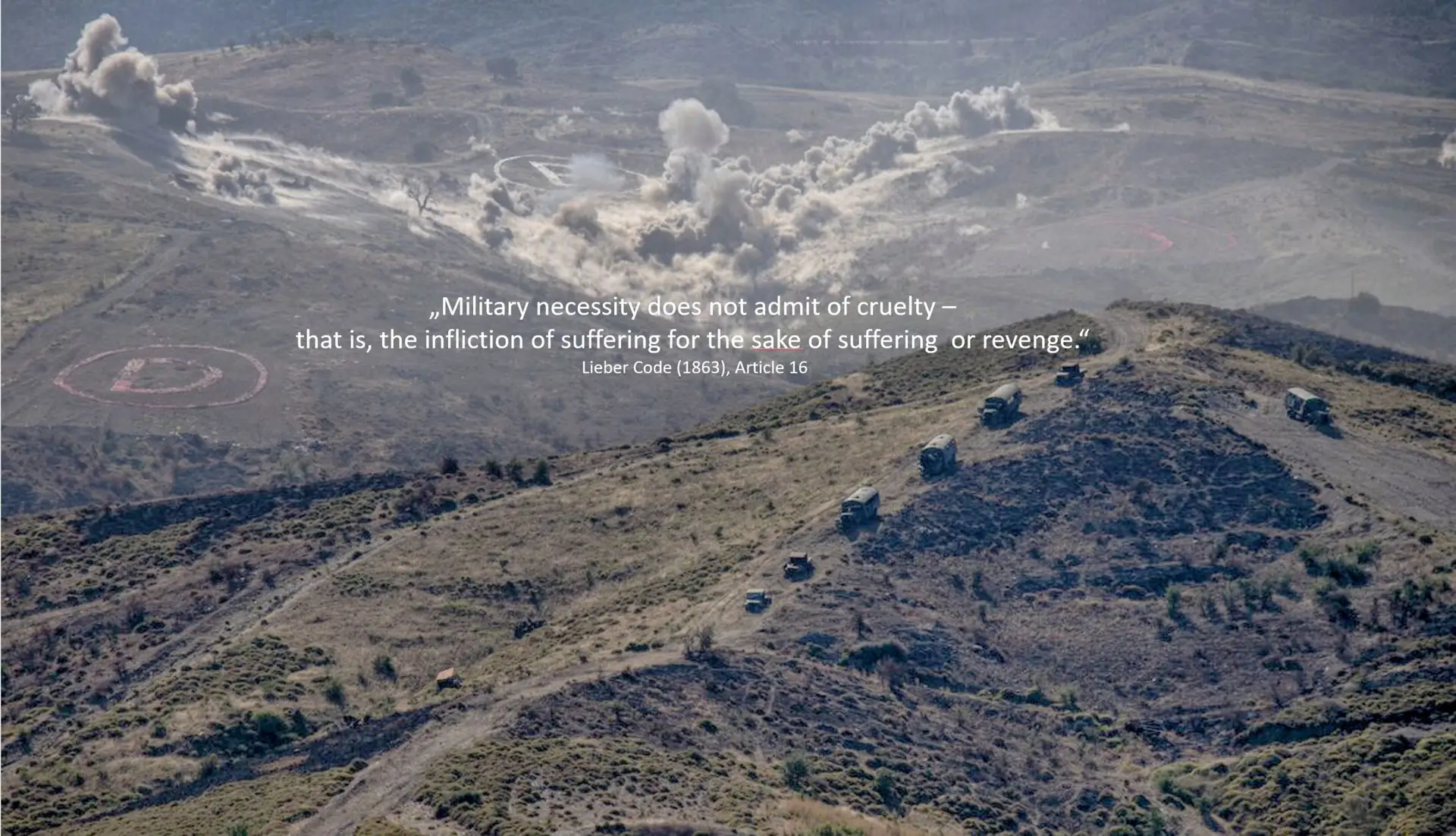
The “Instructions for the Government of Armies of the United States in the Field” of 14 April 1863, which became known as the “Lieber Code,” provided in Article 14 that
“Military necessity, as understood by modern civilized nations, consists in the necessity of those measures which are indispensable for securing the ends of the war, and which are lawful according to the modern law and usages of war.”
This early articulation of the law of war qualified as militarily necessary only conduct that was both indispensable and lawful. It set the stage for subsequent treaty law and the manuals of war created by states for their armed forces.
2. The Hague Regulations of 1907 and Limits on Military Necessity
In Article 22 of the Annex to the Hague Convention IV, the contracting parties agreed that
“The right of belligerents to adopt means of injuring the enemy is not unlimited.”
This rule explicitly acknowledged the right of belligerents to resort to force while simultaneously limiting it.
3. Modern Military Manuals and the Contemporary Understanding of Military Necessity
The U.S. DoD Law of War Manual of 2023, addresses military necessity in § 2.2, which states explicitly that
“Military necessity may be defined as the principle that justifies the use of all measures needed to defeat the enemy as quickly and efficiently as possible that are not prohibited by the law of war.”
Historically, this logic stood in direct contrast to Germany’s military doctrine until the end of the Second World War. This doctrine held that “Kriegsräson geht vor Kriegsmanier”. In plain English: “the logic of war takes precedence over the manner of war”. War criminals used this doctrine to argue that military necessity could justify violations of the customary laws of war.
Today’s understanding rejects that position. The U.S. DoD expressed this compelling logic clearly. It observed that
“military necessity cannot justify departures from the law of war because States have crafted the law of war specifically with war’s exigencies in mind.” (U.S. DoD Law of War Manual, para. 2.2.2.1, p. 54).
The UK Joint Service Manual of the Law of Armed Conflict confirms this now generally acknowledged principle. It states that
“military necessity cannot justify departure from the law of armed conflict.” (JSP 383, 2004 ed., Chapter 2 para. 2.3, p. 23).
The NATO Glossary of Terms and Definitions concurs by defining military necessity as
“The principle whereby a belligerent has the right to apply any measures that are required to bring about the successful conclusion of a military operation and that are not forbidden by the Law of War.”
III. Balancing Military Necessity and the Principle of Humanity in Armed Conflicts
The principle of military necessity and the principle of humanity form a structural tension. Both are at the heart of international humanitarian law. Neither principle operates in isolation; instead, IHL emerges from their continuous interaction.
At this stage, this article references the principle of humanity only insofar as it structures and constrains military necessity. A dedicated and more detailed examination of the principle of humanity will follow in the next instalment of this blog series.
1. Military necessity as a justification for the use of force
Military necessity can justify the use of force “to achieve, as quickly as possible, the complete or partial submission of the enemy” (UK JSP 383, 2004 ed., Chapter 2, para. 2.2.1 c.) States may permit such force under international humanitarian law only where the law of armed conflict does not prohibit it.Military necessity therefore operates within the law, not outside it.
Michael N. Schmitt situates military necessity as a foundational justification within international humanitarian law, observing that:
“the historical underpinnings of military necessity as a justification for divergence from the absolute protection of civilians and civilian objects during armed conflict are carried through and reflected in the entire body of IHL.”
He further emphasises that the principle of military necessity “is not, as sometimes asserted, a limitation on military operations. Instead, the principle recognises the appropriateness of considering military factors in setting the rules of warfare.” (Ibid. at p. 799). In this way, military necessity explains why IHL permits force while simultaneously shaping its lawful scope.
2. Legal limits on military necessity
What would happen if LOAC would allow military necessity to operate without limits? It would risk eclipsing the humanitarian considerations that IHL seeks to protect. Conversely, if belligerents would need to apply humanitarian considerations without regard to military realities, the law would lose operational credibility. International treaty law therefore establishes boundaries that prevent either principle from overriding the other.
Revisiting some core rules of Additional Protocol I to the Geneva Conventions of 1949 (AP I) makes these boundaries visible:
2.1 Limitation of targeting to military objectives
Article 52(2) AP I defines the scope of lawful targeting as follows:
“attacks shall be limited strictly to military objectives.”
Military objectives are “objects which, by their nature, location, purpose, or use, make an effective contribution to military action and whose destruction, capture, or neutralisation offers a definite military advantage“.
Attacks directed at objects that do not meet these criteria are unlawful under IHL. As a result, such attacks cannot be justified by military necessity. This is because the law itself has already defined the limits within which necessity may operate.
2.2 Proportionality as a constraint on military necessity
The principle of proportionality, codified in Article 51(5)(b) AP I, further structures military necessity. International humanitarian law prohibits attacks when commanders expect them to cause incidental civilian harm
“which would be excessive in relation to the concrete and direct military advantage anticipated.”
State practice has firmly established the customary character of this anticipatory assessment It applies in both international and non-international armed conflicts (see the ICRC Customary IHL Study, Rule 14 commentary).
This rule does not negate military necessity. It does not require commanders to ensure that military operations result in no civilian harm. Instead, it requires commanders to weigh anticipated military advantage against expected incidental harm. Where belligerents manifestly exceed that balance, the attack becomes unlawful and, as a consequence, cannot be justified by military necessity.
2.3 Precautions in attack and military necessity
Article 57 AP I complements distinction and proportionality by imposing an obligation to take all feasible precautions in attack. Belligerents must verify that targets are military objectives. Moreover, they must choose means and methods with a view to minimising civilian harm. They must also cancel or suspend attacks if it becomes apparent that the objective is not military or that the expected harm would be excessive.
Failure to comply with these obligations renders an attack unlawful. As with distinction and proportionality, non-compliance deprives the operation of any claim to lawful military necessity.
Taken together, these rules acknowledge the operational necessity of military action while ensuring that the complementary principle of humanity—described by Jean Pictet as the “driving force” of humanitarian law—is respected without leading to operational paralysis.
IV. AI-Enabled Human Judgment of Military Necessity
In recent years, inevitably, the question whether and how artificial intelligence can support human judgments on military necessity has attracted increasing attention, particularly in the context of the inherent right of self-defence against armed attacks under Article 51 of the Charter of the United Nations.
Many commentators focus almost exclusively on the perceived risks of military AI. They argue that AI cannot meaningfully improve human judgment on what is militarily necessary and lawful in armed conflict. Yet, as is often the case, the reality is more nuanced and calls for a balanced assessment.
1. Current AI cannot replace human judgment on military necessity
Determining military necessity is not a mechanical exercise. It is a complex evaluative process that requires the assessment of humanitarian limits on military action. States and treaty drafters expressed these limits in open-textured terms that reflect the historical compromises. These compromises were then embedded in international humanitarian law, in particular in the Geneva Conventions and their Additional Protocols.
Legal scholars and critics of military AI therefore note that notions such as “excessive” incidental civilian harm resist precise quantification.
This difficulty is not merely a limitation of current AI systems. Rather, it is inherent in legal norms that deliberately rely on context-dependent judgment rather than rigid metrics. For this reason, present-day AI cannot replace human judgment in determining military necessity. The responsibility for weighing military advantage against humanitarian constraints must therefore, under the current state of the law and technology, remain with human decision-makers for the time being.
2. The undeniable potential of AI to support human decisions on military necessity
Commanders must assess military necessity in light of all circumstances reasonably knowable at the relevant time, but this requirement does not prevent AI from playing a valuable supporting role. On the contrary, AI-enabled decision-support systems can assist human decision-makers in managing the complexity of modern military operations.
AI can, for example, support assessments of potential military advantage by drawing on large datasets from previous conflicts. It can also analyze established tactical patterns, and use modelling and simulation tools to support this process. Moreover, commanders can use AI in collateral damage estimation processes to inform proportionality assessments with structured, data-driven estimates of likely incidental harm.
In this sense, AI does not determine what is militarily necessary. But it can meaningfully inform the human judgment required to make that determination.
3. A sensible approach to using AI in determining military necessity
Avoiding the unnecessary use of force is not only a humanitarian imperative but also a military one. Commanders and planners can use AI to develop courses of action that are both militarily effective and more protective of the civilian population.
The key to achieving this balance lies not in automation, but in the transparent provision of relevant, actionable information that enables commanders to apply the principles of military necessity and humanity correctly.
Contemporary military decision-making increasingly involves the processing of volumes of data that exceed human cognitive capacity. Consequently, AI has become an important tool for transforming raw data into usable information. Over time, the extent to which AI can support assessments of military necessity will inevitably grow. What matters from a legal perspective at present is that AI functions as a means of structuring and improving human judgment of military necessity, rather than replacing it. But this position may evolve as science and technology and the law develop.
Conclusion: Military Necessity in Law, Practice, and Technological Change
Military Necessity as an Ex Ante Legal Judgment
Military necessity can justify the use of force. At the same time, it is a foundational organizing principle of international humanitarian law, shaped and constrained by humanitarian considerations and operationalised through concrete legal rules. As this post has shown, the law does not treat military necessity as an after-the-fact justification, but as an ex ante judgment that belligerents must exercise under conditions of uncertainty, on the basis of information reasonably available at the time, and within a framework deliberately designed to balance military advantage against civilian protection. This legal architecture already presupposes imperfect information, time pressure, and the cognitive limits of human decision-makers. Far from being an anomaly, uncertainty is an intrinsic feature of warfare that international humanitarian law has long accommodated. Accordingly, the challenge for contemporary armed forces is not to eliminate uncertainty—an impossible task—but to reduce it through the responsible use of AI.
AI and the Application of Military Necessity Under Current IHL
Against this background, we should not assess the growing role of artificial intelligence in military decision-making through categorical assumptions or technological determinism. Under current international humanitarian law, AI does not alter the legal tests governing military necessity, distinction, proportionality, or precautions. Nor does it displace human responsibility for applying those tests. Instead, decision-makers can use AI to structure information, reduce cognitive overload, and make relevant considerations more visible when they take legal and operational decisions.
Governance Choices and the Future of Compliance
How designers, operators, and regulators shape artificial intelligence will ultimately determine whether it strengthens or weakens compliance with international humanitarian law. Used uncritically or opaquely, it may amplify existing risks. Used carefully and transparently, it has the potential to discipline the exercise of military necessity by narrowing discretion and reducing unnecessary use of force.
Continuity and Evolution in International Humanitarian Law
International humanitarian law has never been static. It has evolved in response to changes in the means and methods of warfare, while preserving its core commitment to balancing military effectiveness with humanitarian restraint. We must therefore understand the current debate on AI in that tradition—not as a rupture, but as the next iteration of an enduring legal and operational challenge: how to ensure that decisions taken in war remain both militarily sound and legally justified.
The next article in this series will turn to the principle of humanity itself and examine how it shapes, limits, and complements the lawful exercise of military necessity in contemporary armed conflict.
If you would like to discuss particular aspects of designing military AI systems for IHL compliance or if you have any questions on specific LOAC principles, get in touch with me by email or just give me a call.